The transition to permanent hybrid and remote work models has created significant operational liability for multi-state employers. Many companies hired or relocated out-of-state talent during the initial remote transition without updating their payroll infrastructure, state tax registrations, or worker classifications.
When a remote worker is misclassified, whether as an independent contractor instead of an employee or as exempt from overtime when their actual day-to-day duties require non-exempt status, the compliance exposure cascades across state borders. Employers face retroactive payroll tax assessments, statutory interest, administrative penalties, state-specific wage statement violations, and class action claims under local labor codes.
This deep-dive outlines the primary tax nexus triggers, state-level misclassification standards, wage and hour exposure points, and practical compliance protocols required to audit and manage distributed workforces.
1. The Multi-State Tax Nexus: Unintended Corporate Liability
Hiring a single remote employee in a new jurisdiction usually creates corporate tax nexus for the employer. While business operations may be centered in a state like New York or Delaware, an employee working from a home office in California, Illinois, or Pennsylvania subjects the company to local regulatory authority.
Corporate Income and Franchise Tax Exposure
States apply broad standards when evaluating whether out-of-state entities owe corporate income tax, franchise tax, or gross receipts tax. Under economic nexus rules, an employee performing core operational tasks from a home office establishes physical presence. This can alter state-apportionment factors for income tax, exposing corporate revenue to multi-state filing obligations and back taxes.
Employer Payroll Withholding and Unemployment Insurance
Payroll tax compliance depends entirely on the physical location where the employee performs services, not the state listed on the company’s corporate headquarters address. Failure to register with state departments of revenue and unemployment agencies leads to:
- Unpaid State Income Tax Withholdings: Employers remain liable for uncollected employee state taxes if they fail to withhold correctly at the source.
- SUI Rating Penalties: State Unemployment Insurance (SUI) rates fluctuate by jurisdiction. Migrating workers without updating state unemployment accounts triggers interest charges and misreported wage penalties.
- Local Privilege Taxes: Certain jurisdictions, such as Pennsylvania municipalities or Colorado local districts, impose regional payroll or occupational privilege taxes that standard centralized payroll processors often miss.
2. Independent Contractor Misclassification in Distributed Teams
Companies often attempt to mitigate multi-state tax and administrative friction by classifying remote workers as independent contractors. However, state labor departments and taxing authorities apply strict tests to evaluate worker status, independent of how the parties label the contract.
The ABC Test vs. Common Law Standards
More than half of U.S. states, including California under California Labor Code Section 2775 and Massachusetts under M.G.L. c. 149 § 148B, apply variations of the ABC Test. Under this standard, a worker is presumed to be an employee unless the hiring entity proves three specific conditions:
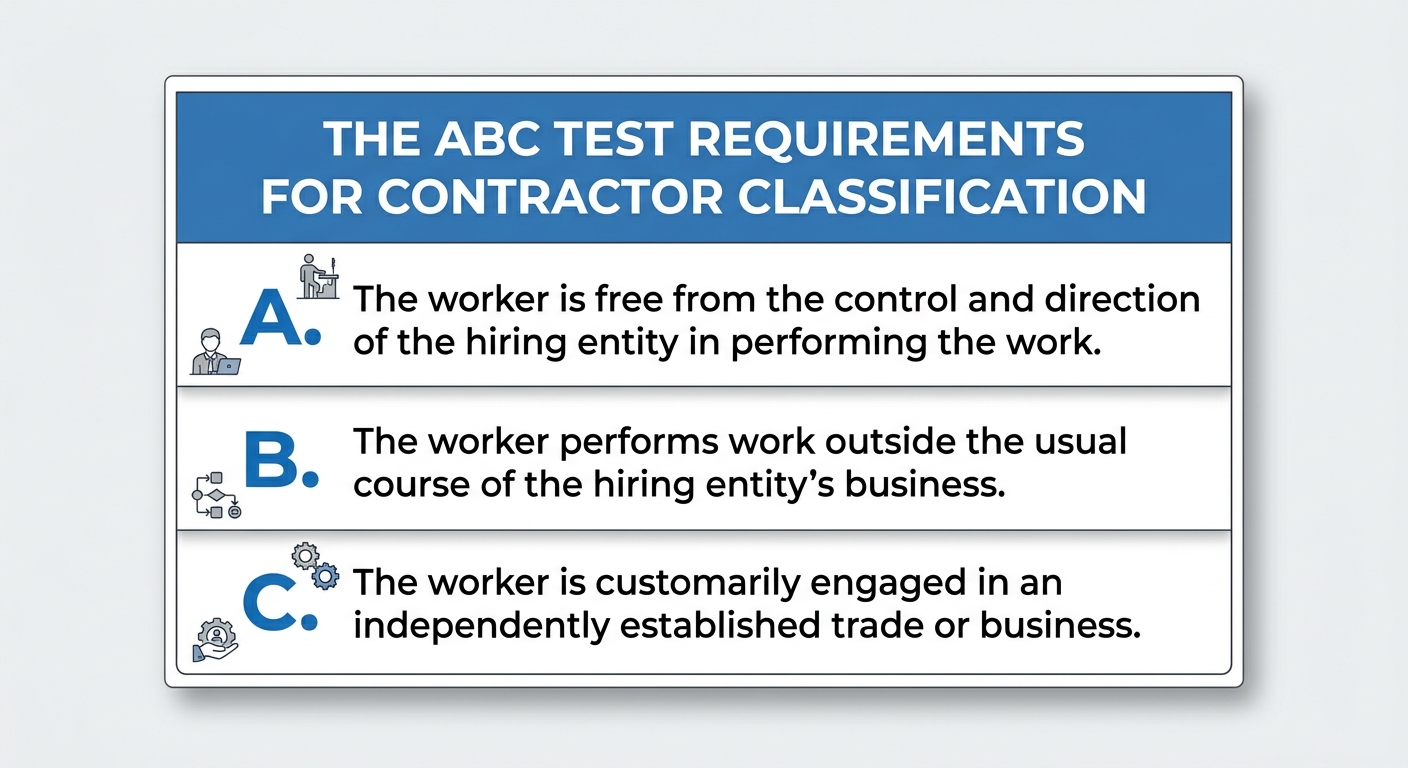
This standard focuses on financial dependence, opportunity for profit or loss, investment in tools, and permanence of the working relationship.
Penalties for Incorrect Contractor Status
When state agencies determine a remote worker was misclassified as an independent contractor, penalties accrue quickly:
- Unpaid Wage Claims: Back wages, minimum wage adjustments, and unpaid overtime calculations under state labor codes.
- Mandatory Expense Reimbursement: States like California, Illinois, and New York require employers to reimburse employees for necessary home-office expenses, including cell phone usage, high-speed internet, computer hardware, and ergonomic equipment.
- Workers' Compensation Liability: Failure to secure local workers' compensation insurance coverage exposes leadership to civil fines and potential criminal enforcement.
3. Remote Exempt vs. Non-Exempt Misclassification & Wage Risks
Misclassifying a full-time remote worker as an exempt salaried employee presents another major financial liability for multi-state employers.
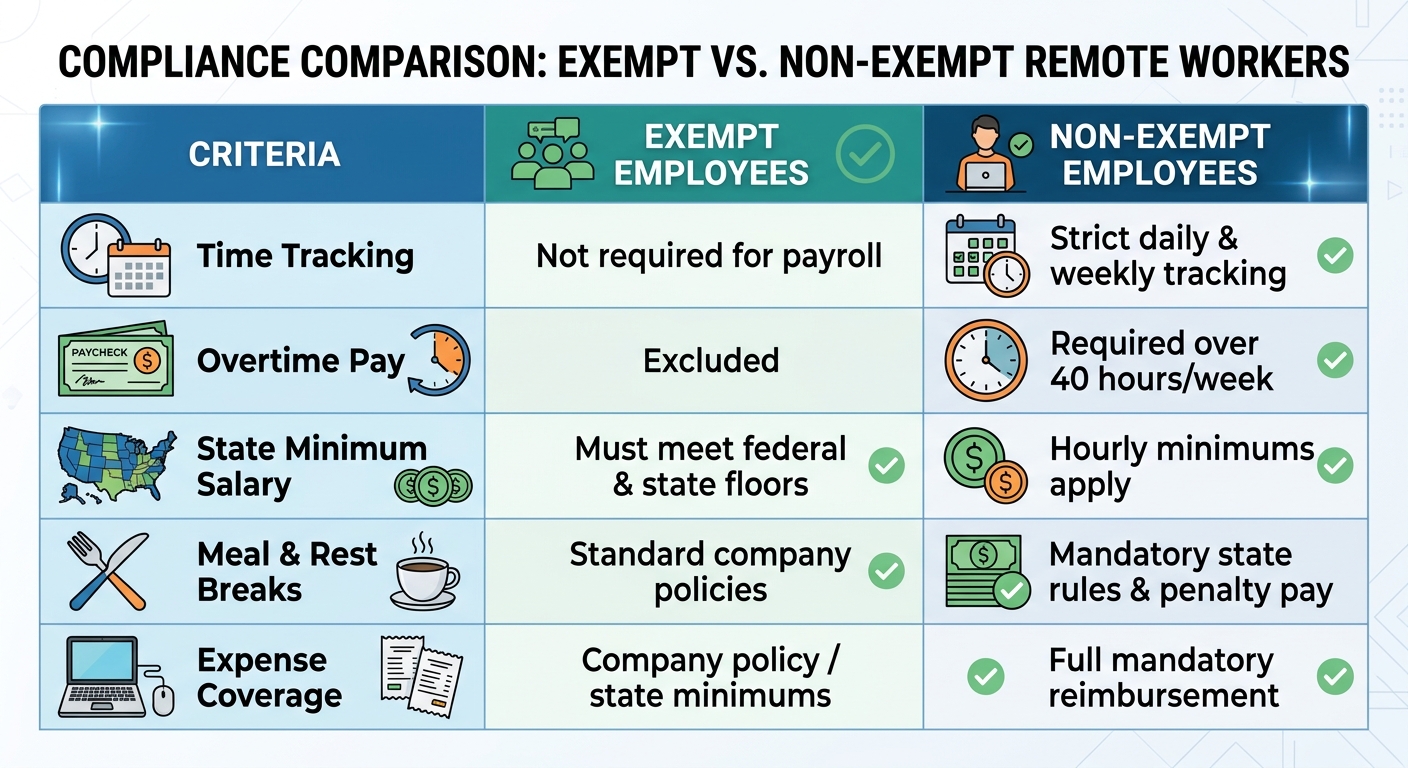
Remote work environments obscure hours worked. Non-exempt employees frequently check emails outside core hours, answer messaging channels, or perform administrative tasks off the clock. Without proper time-tracking systems, these unrecorded hours accumulate into substantial unpaid overtime liabilities.
High-Risk State Wage Rules
- Higher State Salary Thresholds: Meeting the federal salary test under the FLSA is insufficient in states like New York, California, and Washington, where exemption salary thresholds are significantly higher than the federal baseline.
- Daily Overtime and Meal/Rest Penalties: States like California require overtime pay for hours worked beyond eight in a single day, regardless of weekly totals. Employers must also provide compliant, uninterrupted meal and rest breaks. Failure to track these breaks for remote staff creates exposure to statutory premium pay claims.
- Paystub and Wage Statement Violations: Jurisdictions like New York require itemized wage statements detailing hourly rates, regular hours, overtime rates, and employer contact information. Failing to issue localized, compliant paystubs exposes companies to statutory civil penalties up to $5,000 per employee under the New York Wage Theft Prevention Act.
For an in-depth analysis of how cross-border worker disputes interact with state enforcement mechanisms and forum choices, see our analysis on Multi-State Non-Competes & Restrictive Covenants: Key Enforceability Challenges.
4. Employer Action Plan: Auditing and Remediating Misclassification
To limit multi-state liability, companies should audit their remote workforce operations using a systematic, four-part compliance framework:
Step 1: Conduct a Multi-State Physical Footprint Audit
Catalog the actual physical location of every remote worker, contractor, and hybrid employee. Do not rely on initial hiring addresses. Implement a clear internal policy requiring advance notice and approval before an employee relocates to another state or works temporarily from a secondary jurisdiction.
Step 2: Evaluate Independent Contractor Relationships
Review all active 1099 agreements against the applicable state legal standards, such as the ABC Test, where the contractor physically resides. Transition high-risk contractors, particularly those performing core product development or operational roles, to W-2 employee status using structured remediation or voluntary disclosure programs.
Step 3: Implement Remote Time-Keeping and Expense Policies
Establish clear, mandatory time-keeping procedures for non-exempt remote workers. Prohibit off-the-clock work and implement automated time-entry platforms. Update remote work policies to define covered business expenses, establishing clear monthly stipends or direct reimbursement mechanisms for home office equipment, software licenses, and internet costs.
Step 4: Localize Payroll and Statutory Disclosures
Ensure your payroll provider is registered with all relevant state tax, unemployment, and labor departments. Verify that employee paystubs reflect the localized statutory disclosures required in the worker's home state, including accurate accrued sick leave balances and localized wage rates.
Practical Guidance
Cross-border worker misclassification creates compounding tax, labor, and corporate exposure that grows over time. Proactive internal audits allow companies to fix classification mistakes, correct state payroll registrations, and re-structure remote workforce contracts before state audits or class action litigation begin.
To audit your remote workforce, review independent contractor agreements, or structure multi-state compliance programs, reach out to Bochner PLLC’s Labor and Employment practice group.